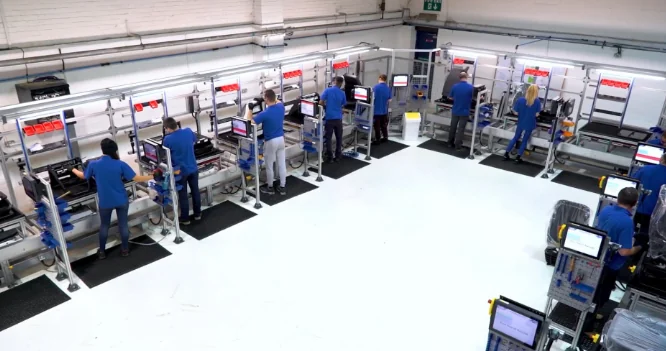
Cell Manufacturing is a visual assembly guidance system designed for autonomous manufacturing cells where complex assemblies are built. It guides the operator step by step, showing the exact components and tools, reducing the learning curve and preventing errors in multitasking processes.
Advantages of Cell Manufacturing
Transform complex assembly processes into guided, intuitive routines, increasing operational flexibility and guaranteeing maximum quality in every work cell.
1
Optimal quality control and traceability, recording key data per batch or product
2
Drastic reduction in cycle times by automating assembly sequences
3
Operational flexibility and multi-skilled staff thanks to visual guidance
4
Cell space optimisation (Lean Cell), organising locations and tools
How Does the Cell Manufacturing Solution Work?
In the work cell, light indicators are integrated into every shelf or container, together with an industrial touchscreen showing step-by-step instructions. The system lights up the indicator at the location of the exact component to be assembled and shows the corresponding tool. The operator confirms each step by pressing the indicator button or via Poka-Yoke sensors, ensuring that no step is skipped before the cell is authorised to close.
Who Is Cell Manufacturing For?
This solution is aimed at manufacturing plants that produce complex industrial products, or products with a wide variety of models, in autonomous, flexible work cells.
It is ideal in production environments with high staff turnover or frequent product changes (High-Mix, Low-Volume), guaranteeing maximum quality without relying on the operator’s prior knowledge for the assembly of complex products.
How Long Does It Take to Implement Cell Manufacturing?
Cell Manufacturing is commissioned modularly over an estimated period of 2 to 3 weeks per work cell.
Process Specification (Week 1): Mapping of the cell sequences and integration of the bill of materials (BOM).
Equipment and Integration (Week 2): Installation of hardware in the cell (lights, screens, sensors) and communication with the ERP/MES.
Start-up and Validation (Week 3): Cycle time adjustment, Poka-Yoke testing and staff training.
How does Cell Manufacturing help manage a high variety of products (High-Mix Low-Volume)?
The system digitally loads the assembly instructions according to the active work order. When the model being manufactured changes, the lights and visual instructions adapt instantly, allowing changeovers with no readjustment time and no risk of confusion.
Can torque or verification tools be integrated into the cell?
Yes. The solution communicates with electronic screwdrivers, torque wrenches and control gauges. The system does not allow the next step until the tool confirms that the required tightening torque or dimension has been reached.
What advantages does it offer over paper work instructions posted in the cell?
Replacing paper with dynamic visual guidance eliminates time lost reading, avoids working with outdated drawing versions and ensures that 100% of operations are carried out in the correct sequence with no omissions.
Get in touch
Tell us how you currently manage order picking or manufacturing processes and we will help you find the Pick To Light solution that best suits your company’s needs.

 EN