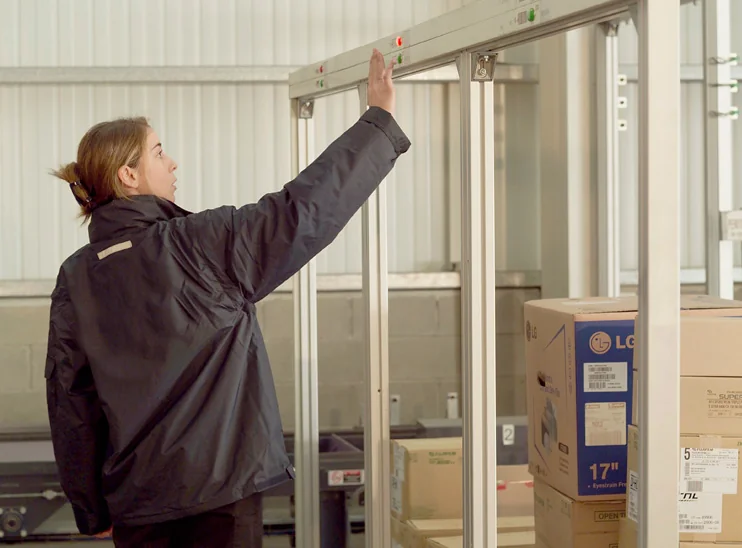
Cross Docking is a solution based on the Put to Light system in which incoming goods are sorted directly into the orders that need them, without going through storage. It cuts storage costs and speeds up sorting and distribution.
Advantages of Cross Docking
Implementing Cross Docking brings immediate benefits to your warehouse operations through two key advantages.
1
Cost Savings: Eliminates space and inventory-holding costs
2
Maximum Operational Efficiency: the whole process is immediate, with no intermediate storage
How Does the Cross Docking Solution Work?
Cross Docking works as a continuous flow. First, goods are unloaded at the inbound docks and their labels are scanned. Then, the Put to Light system turns on lights to show where to place each product, arranging the boxes in the exact order of the delivery route. Finally, the packages are loaded directly onto the outbound vehicles. The entire process is immediate and no storage racking is used.
Who Is Cross Docking For?
This solution is designed for businesses with high-turnover or high-volume products that ship out the same day they arrive. It is also ideal for combining goods from several suppliers into a single shipment and for arranging trucks in route order, so the carrier does not waste time looking for boxes at each stop.
How Long Does It Take to Implement Cross Docking?
The implementation time for Cross Docking depends on the number of sorting zones, the size of the consolidation area and the coordination with your systems and suppliers.
Each project begins with a prior analysis of your operation to size the solution and estimate an implementation timeline tailored to your case.
Can cross docking be applied to goods of any size?
Yes, cross docking can be applied to goods of virtually any size, from small components to palletised loads or oversized products. What matters most is not the physical size of the goods but the ability to efficiently coordinate their receiving, sorting and dispatch without having to store them for long periods.
Is cross docking viable for my company?
The viability of cross docking depends mainly on demand predictability, coordination with suppliers and the ability to synchronise logistics operations. To find out how to implement it in your case, just get in touch with us by filling in the form on our website or by writing to infoweb@ptlsystems.com. That way, our team can analyse your case, answer any technical questions and provide a personalised quote.
What logistics savings can it generate?
The cost reduction comes mainly from fewer storage-related activities. By reducing goods handling, occupied space and dwell time in the warehouse, companies can optimise their resources and improve operational efficiency.
In addition, cross docking can help reduce indirect costs associated with inventory management, product damage, obsolescence and internal goods movements.
Get in touch
Tell us how you currently manage order picking or manufacturing processes and we will help you find the Pick To Light solution that best suits your company’s needs.

 EN